

Best Defibrillators for Offices in 2026: Buyer’s Guide
More than 115,000 Out-of-Hospital Cardiac Arrests (OHCA) are reported to the ambulance services each year in the UK. With less than 1 in 10 currently surviving, this low survival rate can be partly attributed to slow response time when someone collapses from a cardiac arrest.
Treatment in the form of CPR and defibrillation is most effective if began immediately, and can lead to survival rates as high as 74% if a shock is delivered within 3 to 5 minutes of collapse.
Survival chances for someone suffering a cardiac arrest fall by around 10% for every minute they are without treatment; in an office environment, having the right automated external defibrillators (AEDs) on site can be the difference between life and death.
In this buyer’s guide, we will highlight the best defibrillator for offices and explore which AEDs are ideal for untrained users in the workplace.
Why offices need a defibrillator
While offices may be perceived as a low-risk environment for cardiac arrest due to no high intensity exercise or activity, Sudden Cardiac Arrest can strike at any time and can affect even seemingly healthy individuals.
A sedentary lifestyle such as sitting at a desk daily can also contribute to potential heart issues which can exacerbate the risk of Sudden Cardiac Arrest.
Legal requirements for workplace AEDs in the UK
While there is not yet a UK mandate to install a defibrillator in workplaces, most businesses have opted to protect their employees by placing at least one defib on the premises.
The Resuscitation Council UK and British Heart Foundation strongly recommend having AEDs available in busy or high-risk workplaces, particularly those with larger teams, an older workforce, or locations where access to emergency medical services may take longer.
What to look for in an office defibrillator
Ease of use
A defibrillator should be easy for anyone to pick up and use to save a life, whether they have been trained or not. All modern AEDs feature step-by-step instructions which guide the user through every step of a rescue.
Portability & Size
To be easily used in an office environment, a defibrillator should be highly portable and small to be easily carried to wherever the emergency has taken place within the building, as well as being compact enough to be stored easily within a potentially busy environment.
Maintenance Requirements
An important factor when purchasing an office defibrillator is ongoing costs related to AED maintenance and replacement consumables (electrode pads and batteries). Devices with longer life pads and batteries have lower ongoing costs, but may have a higher upfront cost.
Defib Warehouse offer a 3 or 5 year maintenance contract, suitable for businesses, taking away any worry involved with owning a defibrillator with annual servicing and more. Learn about our maintenance contracts here.
CPR Feedback
CPR feedback matters most in an office where the person doing CPR may never have done it outside a training session. AEDs with real-time CPR feedback (for example ZOLL’s Real CPR Help® technology) talk the first aider through compression rate and depth as they go. If your workplace has first-aid novices, this feature is worth prioritising over a small price saving.
IP Rating
We recommend to look for an IP rating of at least IP54. Most of the AED models mentioned below are rated IP55 or higher, which covers dust ingress and water splashes.
Warranty
The standard manufacturer warranties on most of the automated external defibrillator models typically range from 5 to 10 years, with most them lasting around 7 to 8 years. Defib Warehouse offers the peace of mind to extend any defibrillator warranty to 10 years at checkout for a one-off fee.
Best Fully Automatic AEDs for Offices in 2026
Primedic HeartSave myPAD – Best for portability and size
Primedic HeartSave myPAD Core Defibrillator
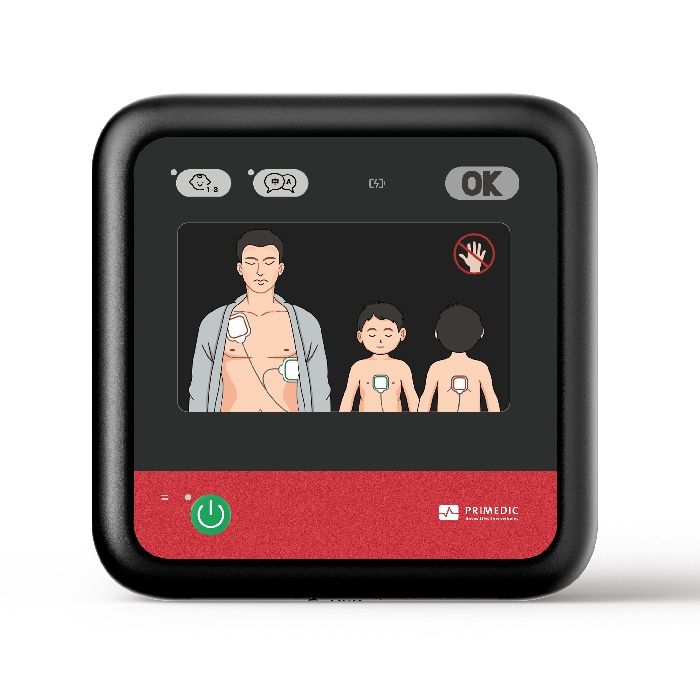
The latest fully automatic defibrillator from Primedic, the HeartSave myPAD Core AED is among the smallest defibrillators on the market at just 1.1kg and 15cm by 15cm.
This makes the myPAD Core suitable for an office due to its ability to be easily stored, and carried quickly to an emergency in the event of a cardiac arrest.
This variant comes with an 8-year standard manufacturer’s warranty (which can be extended to 10 years at checkout), carries an IP66 rating (one of the highest of any AED on the market) and is priced at £875+VAT.
Buy the myPAD HeartSave Core AED here
Primedic myPAD HeartSave LCD Defibrillator
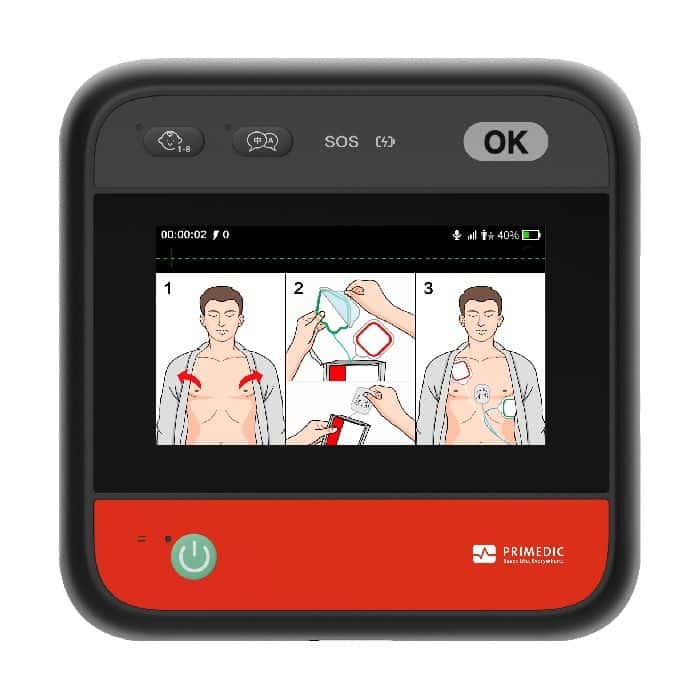
The myPAD AED is also available in a variant with an LCD screen, adding more detailed instruction and feedback for the user.
The LCD version comes with an 8-year standard manufacturer’s warranty with optional extension up to 10 years at checkout. It also carries an IP66 rating and is priced at £975+VAT.
With a lifespan of up to 5 years on both the defib pads and batteries, the myPAD offers ongoing value.
Buy the myPAD HeartSave LCD AED here
DefiSign LIFE – Best for upfront value
DefiSign LIFE Defibrillator
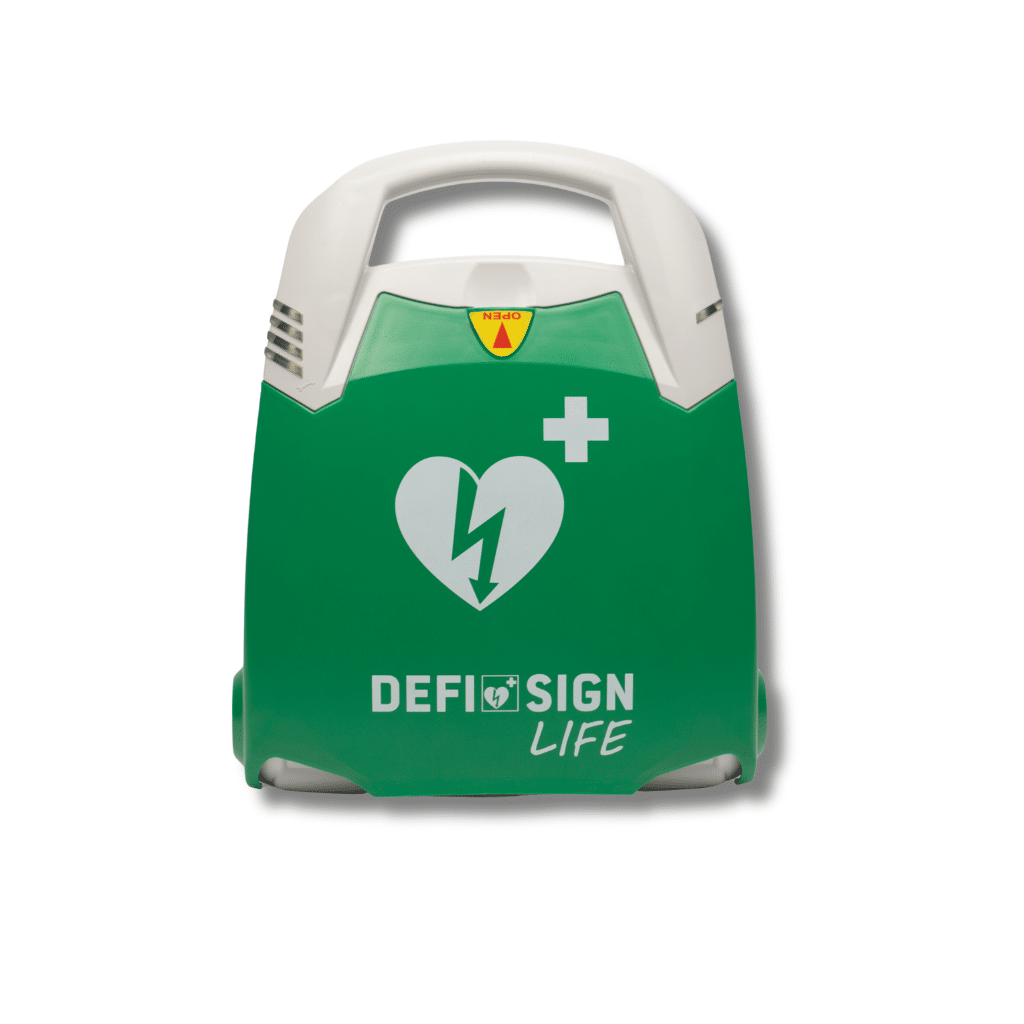
The DefiSign LIFE Fully Automatic Defibrillator benefits from a low upfront cost at just £825+VAT, making it one of the most cost-effective defibrillators on offer.
The DefiSign also features an extended battery life of up to 6 years, allowing for business budgets to have an extended period without factoring in replacements.
It’s rated IP55 for dust and water resistance and comes with a 10-year manufacturer’s warranty with a 2-year shelf life on electrode pads.
Buy the DefiSign LIFE AED here
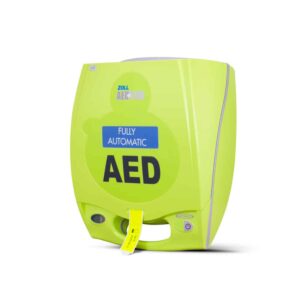
ZOLL AED Plus – Most well known
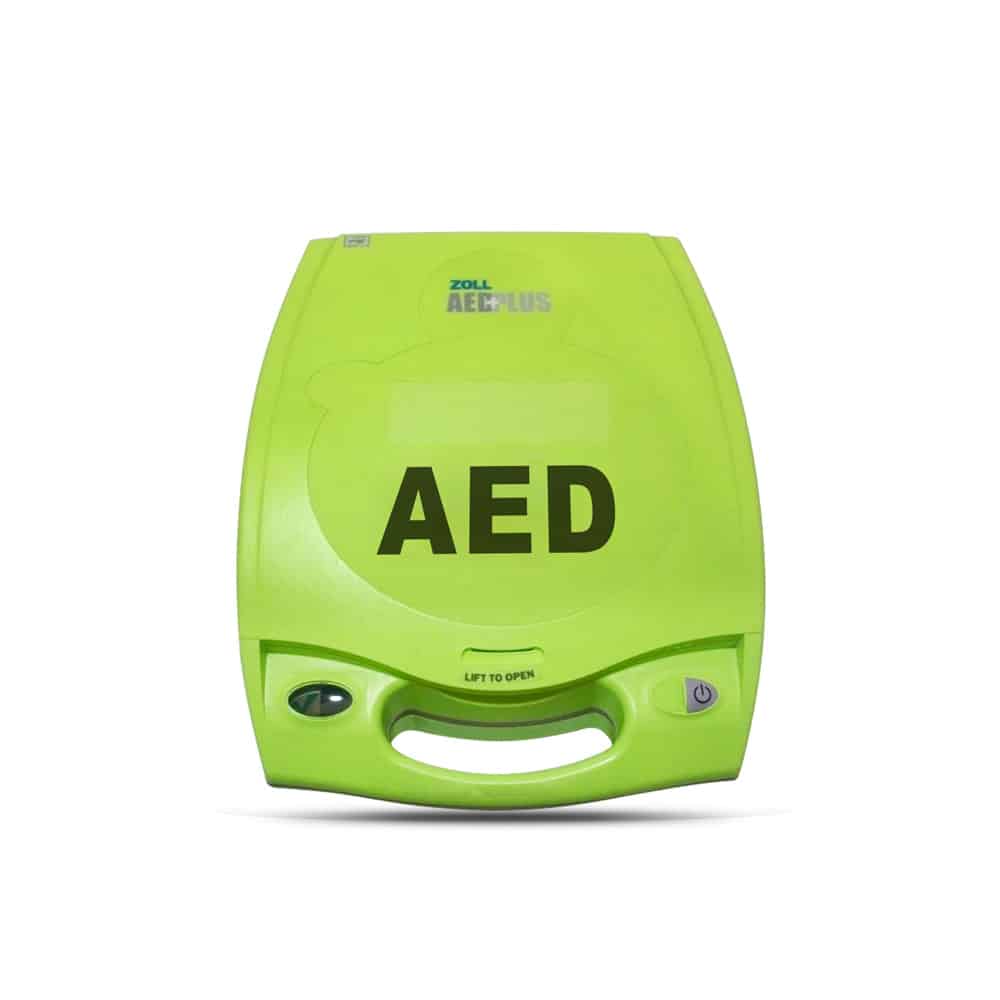
ZOLL AED Plus Defibrillator
The ZOLL AED Plus Fully Automatic Defibrillator is one of the most well-known defibrillators globally, from AED giants ZOLL Medical. The AED Plus has been trusted for over 20 years and can be seen across the UK.
This defibrillator comes with Real CPR Help®, giving rescuers live audio, text, and visual feedback on chest compression depth and rate. It is a genuinely useful feature in an office where the person doing CPR may have no first-aid background.
It carries an IP55 rating, a 5-year shelf life on its CPR-D-padz® electrodes, and a 5-year warranty (extendable to 7 years free of charge when you register the device with ZOLL).
Priced at £895+VAT, the AED Plus is the perfect balance of value and premium name power.
Buy the ZOLL AED Plus AED here
Note: Prices are correct at the time of writing and subject to change.
How many defibrillators does your office need
As a practical rule of thumb, most small-to-medium offices only need one centrally placed AED as long as the first-aider can walk to it and back within three to five minutes from any desk or meeting room.
For larger workplaces, here is a sensible guide:
- Single floor (less than 50 staff): One AED placed in a central, visible spot, like the main reception or central corridor.
- Multi-floor buildings: One AED on every floor (or within each designated fire zone) to save anyone having to race up or down stairwells in an emergency.
- Campuses or multiple buildings: Treat each building as an independent site and work out its needs separately.
Automatic or Semi Automatic AEDs
Most AEDs come with the option of fully automatic or semi-automatic, both of these types of defibrillator will analyse the casualty’s heart rhythm and decide whether a shock is required.
The key difference is that semi automatic AED defibrillators such as the Philips HeartStart FRx semi-automatic AED will instruct the user that a shock is required, and instruct them to push a flashing button to deliver the shock. Fully automatic AED defibrillators will also advise that a shock is required but will instead start a countdown from three before delivering the shock itself.
More experienced users may prefer to have more control over the rescue and thus opt for semi-automatic, whereas more untrained users may prefer fully automatic as this takes more onus off them.
Sources:
- Resuscitation Council UK. Epidemiology of Cardiac Arrest Guidelines. Published October 2025
- Resuscitation Council UK. Making Defibs Accessible 24/7 Helps Increase Survival Rates. Published October 2023
- University of Warwick (Warwick Medical School). Out-of-Hospital Cardiac Arrest Outcomes.