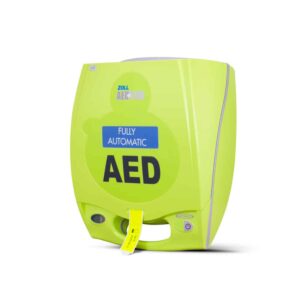


BS 8599-1:2019+A1:2026 Guidance on Workplace AEDs and First Aid Kits
The British Standard for workplace first aid kits (BS 8599-1) has been amended to include guidance on the provision and placement of Automated External Defibrillators (AEDs) in the workplace.
This guide explains what the BSI standard says, what changed in the 2026 amendment, how it relates to the UK health and safety law, and how to review your own workplace step by step.
Key points at a glance
- BS 8599-1 covers the contents of workplace first aid kits, their containers, and the provision and placement of workplace AEDs.
- The 2026 amendment adds personal issue kits and critical injury packs, renames the travel kit, and changes quantities in small, medium and large kits.
- Under the standard, businesses estimated to have 5 or more people on site during operating hours should provide an AED.
- An AED should be accessible within 2 minutes from any location on the premises, so retrieval time matters as much as ownership.
- BS 8599-1 is a British Standard, not legislation. An employer’s legal duties come from the Health and Safety (First-Aid) Regulations 1981 and the workplace’s first aid needs assessment.
What is BS 8599-1:2019+A1:2026?
BS 8599-1:2019+A1:2026 is published in April 2026 by the British Standards Institution (BSI) Limited as Workplace first aid kits, Part 1: Contents of first aid kits and provision of Automated External Defibrillators (AEDs) in the workplace.
The latest edition of the BS 8599 applies to any workplace environment in the UK. It is Part 1 of a two-part series; Part 2, BS 8599-2 covers motor vehicle first aid kits.
What changed in BS 8599-1:2019+A1:2026?
- Two minute AED accessibility. The standard formally sets out that any workplace with 5 or more people on site during operating hours should provide an AED that is retrievable within 2 minutes from any location on the premises.
- New first aid kit categories. Specialised kits such as critical injury packs, personal issue kits, burns kits and eye wash kits have been added for high-risk or hazardous environments.
- Revised kit quantities. The quantities of the contents in small, medium and large first aid kits for workplaces have been changed.
- Remote and offsite workers: Employers should give considerations to remote employees working from home or in a vehicle.
Defibrillator guidance under BS 8599-1
What does the standard say about AEDs in the workplace?
The standard recommends that businesses with 5 or more people on site during operating hours should provide an AED on their premises.
Employers should make a realistic estimate of both peak and regular occupancy in the workplace.
The estimated headcount includes:
- Direct employees and remote staff visiting the business premises
- Contractors and delivery personnel
- Customers, visitors and members of the public
The standard also asks employers to give consideration to offsite workers, drivers or field engineers who work away from the workplace, when thinking about AED access.
The 2-minute retrieval test
A workplace AED should be clearly displayed in an unlocked cabinet or wall mounted, and must be retrieved within 2 minutes from any location on the business premises.
Larger or multi-story facilities will often require multiple AEDs strategically placed in open-access locations so responders can retrieve them without delay or physical obstruction.
Why speed matters: Resuscitation Council UK reports that defibrillation within 3 to 5 minutes of collapse may produce survival rates as high as 50% to 70%. Every minute of delay reduces the chance of survival by approximately 10%.
| Site type | Why one AED may not be enough |
| Large warehouse or distribution centre | A single AED placed in the reception can be minutes away from the far end of the building. |
| Multi-storey building | Stairs, lifts and security doors slow down retrieval time from upper floors. |
| Manufacturing plant | Complex layouts, restricted areas, high noise and large floor plans increase response times. |
| Construction site | Layouts change as work progresses, requiring frequent review of AED positions. |
| Multi-building site or campus | A single central AED may not be reachable within 2 minutes from other buildings on the same site. |
Tip: Time the physical walking route from the furthest corner of the site to the AED, rather than estimating distances on a floor plan.
Is BS 8599-1 a legal requirement?
No. BS 8599-1 is a voluntary standard, not a legal requirement, and the compliance with a British Standard does not offer immunity from legal health and safety obligations.
Employers’ legal duties on first aid come from the Health and Safety (First-Aid) Regulations 1981. These Regulations require employers to provide adequate and appropriate equipment, facilities and trained personnel so that people receive immediate first aid if injured or taken ill at work.
This applies to all workplaces, including those with fewer than five employees, and the self-employed. Your first aid needs assessment is what determines what is appropriate for your site.
Employers are not legally required to buy first aid kits that comply with BS 8599-1 standard, the Health and Safety Executive (HSE) references the BS8599 as a recognised industry benchmark.
Employers should document their AED considerations and conclusions within their First Aid Needs Assessment.
If you are unsure what applies to your workplace, speak to your health and safety adviser or consult HSE guidance.
Overview of workplace first aid kits
The BS 8599-1 standard defines several first aid kit types. The right kit depends on your workplace’s risk assessment and headcount.
| Kit type | Application |
| Small, medium and large first aid kits | Core workplace kits sized according to the number of people and risk level. |
| Travel and motoring first aid kit | For employees working remotely in company cars, vans, tractors and commercial vehicles. |
| Personal issue first aid kit | A small basic kit for lone workers, issued as a supplement to the main workplace kits. |
| Critical injury pack | For high-hazard environments, such as heavy machinery, power tools or construction sites. Contains tourniquets and haemostatic dressings for severe bleeding. |
| Burns first aid kit | For areas with a high risk of burn injuries. Includes burns dressings where rapid access to 20 minutes of running water is limited. |
| Eye wash first aid kit | Recommended for environments with chemical hazards, airborne dust, particles or debris. |
The exact quantities for each first aid kit type are set out in Table 1 of the standard. It’s recommended that employers review their existing kits against the current edition.
Additional items for specific hazards
Standard workplace kits are designed for treating common injuries.
However, if your risk assessment identifies specific hazards such as potential hydrofluoric acid (HF) exposure or lithium-ion battery electrolyte leaks, the standard recommends adding specialised treatments (such as calcium gluconate gel) alongside staff training.
HSE provides a free risk assessment template and examples at hse.gov.uk.
Containers and marking guidelines
First aid containers must securely hold all contents, protect items from dust and moisture, and undergo routine checks. Under BS 8599-1, containers should be legibly marked with:
- Reference code and date of the standard: BS 8599-1:2019
- White cross first aid symbol (BS EN ISO 7010 type E003)
- The words “FIRST AID” in clear white text
- Clear markings on supplementary kits (e.g: Critcal Injury Pack)
- Safety symbol on AED cabinet (BS EN ISO 7010, type E010)
Checklist to review your workplace first aid kits and defibrillator setup
- Review your workplace’s first aid needs assessment and record any changes in headcount, risk levels or layout.
- Estimate maximum and regular occupancy during peak hours, including employees, visitors, contractors and the public.
- If 5 or more people are estimated to be on-site during operating hours, decide what first aid kits and AEDs are required on the premises.
- Check that an AED can be retrieved and brought back within 2 minutes round trip from any area on the site.
- Verify AED’s position, visibility, directional signage and accessibility to guide responders to the device in an emergency.
- Routinely inspect AED and keep the consumables (battery & electrode pads) within date. Any faults or warning indicators should be resolved immediately.
- Choose an indoor or outdoor defib cabinet suited to the workplace environment and keep it unlocked for easy retrieval.
- Register public access AEDs on The Circuit (the National Defibrillator Network) and keep its location, access details and status up-to-date.
- Compare existing first aid kit quantities and sizes with the current BSI standard as well as provision of supplementary kits in high-risk environments.
- Review CPR, AED and wider first aid training or awareness arrangements.
Sources and further reading
- BS 8599-1:2019+A1:2026, Workplace first aid kits – Part 1, BSIgroup.com
- Health and Safety (First-Aid) Regulations 1981 and HSE first aid at work guidance, hse.gov.uk
- Resuscitation Council UK, Quality Standards: CPR and AED training in the community, resus.org.uk
- The Circuit, the National Defibrillator Network, thecircuit.uk
- British Healthcare Trades Association (BHTA), Suggested performance specification for defibrillator cabinets, bhta.com
Frequently asked questions
It is the amended British Standard for workplace first aid kits which, for the first time, also covers the provision of AEDs in the workplace.
No. It is a British Standard, not legislation. Employers must still meet the Health and Safety (First-Aid) Regulations 1981 and base their arrangements on a needs assessment.
There is no legal mandate requiring every workplace or business to install an AED. The standard says businesses estimated to have 5 or more people on site during operating hours should provide one, which makes it a strong benchmark to assess against.
The standard refers to people on site and asks for a realistic estimate of maximum and regular occupancy, so it makes sense to include contractors, visitors and customers as well as staff.
An AED should be accessible within 2 minutes from any location on the premises. An AED in a secure area does not count as accessible.
Possibly. Large, multi-storey or multi-building sites may need additional AEDs if the device cannot be retrieved within 2 minutes from any area of the site.
The BSI standard specifies that an AED should be clearly displayed within a unlocked cabinet or wall mounted in an open access area. If placed outdoors or in shared premises, use a defibrillator cabinet with suitable weather and temperature protection.
Disclaimer: This guide provides general information to help you understand the new Bristish Standard BS 8599-1:2019+A1:2026 and should not be treated as legal or medical advice. It does not replace a documented first aid needs assessment, professional advice from a qualified health and safety adviser or current HSE guidance.